China Top Residential Overhead Door Manufacturers?

China has become a major sourcing market for residential garage doors and related hardware. Yet identifying the top manufacturers requires more than checking export volume or attractive catalog photos. A reliable comparison should examine factory experience, engineering capability, material consistency, and after-sales support.

This guide explores manufacturers serving the overhead door residential market. It considers insulated steel panels, aluminum frames, torsion springs, tracks, openers, and weather seals. These details affect daily comfort and long-term performance. A well-built door should move quietly, close evenly, and resist rain entering beneath the bottom seal. Factory testing, production records, and customer references also matter.

No supplier is perfect.

Some factories offer strong customization but weaker documentation. Others provide excellent samples, yet communication becomes slower after payment. That gap deserves attention. Buyers should request installation drawings, cycle-test information, coating specifications, warranty terms, and replacement-part policies. Independent inspections can also reveal uneven panel joints, poor welding, or fragile packaging before shipment.

The manufacturers discussed here are not ranked only by advertising claims. Their production depth, quality controls, export experience, and response to technical questions provide a more useful basis. Regional climate also changes the decision. Coastal projects may need stronger corrosion protection, while colder areas require better insulation and flexible seals.

This overview is intended for distributors, builders, and homeowners comparing Chinese suppliers. It offers practical guidance, not a universal verdict. Careful verification remains essential.

China Top Residential Overhead Door Manufacturers?

Residential Overhead Door Manufacturing in China

China Top Residential Overhead Door Manufacturers?

Residential Overhead Door Manufacturing in China is moving toward insulated panels, quieter motors, and smarter access control. Fortune Business Insights reported that the global garage door market reached about USD 3.35 billion in 2023. It also forecasts a 6.1% CAGR through 2030. This growth encourages Chinese factories to improve steel forming, polyurethane insulation, spring systems, and powder coating. Experienced buyers should inspect panel thickness, thermal performance, cycle testing, and corrosion resistance. A polished sample is not enough.

Manufacturers usually support customization for opening sizes, colors, window sections, and control systems. Production quality still varies. Some workshops offer excellent welding and packing, while others depend too heavily on final inspection. That is a weakness worth admitting. Ask for batch records, material certificates, motor test results, and clear installation drawings. TÜV Rheinland’s 2024 Industry 4.0 studies also highlight stronger traceability as a practical advantage of connected manufacturing. It can reduce unnoticed defects, but software cannot replace skilled inspection.

Tips: Request one complete sample before volume production. Measure panel alignment, seal compression, noise, and emergency release by hand. Confirm wind-load calculations for the destination site. Check whether spare springs, rollers, and remotes remain available for several years. The cheapest quotation may become expensive after installation.

Key Types of Residential Overhead Doors

Key Types of Residential Overhead Doors

Residential overhead doors usually fall into four practical types: sectional, roll-up, tilt-up, and side-hinged designs. Sectional doors use hinged panels that travel along ceiling tracks. They suit compact driveways and provide reliable weather sealing. Roll-up doors save overhead space, but their slats may offer less insulation. Tilt-up doors use one solid panel. They need clear space outside the garage during operation. Side-hinged doors open like traditional doors and work well in garages used for frequent pedestrian access.

Material and insulation change daily performance. Steel sectional doors resist dents and need limited maintenance. Aluminum weighs less, while wood offers a warmer appearance but demands more care. The International Energy Agency’s Energy Efficiency 2023 report states that buildings consume about 30% of global final energy. An insulated door can reduce heat transfer, especially in attached garages. However, insulation alone cannot correct poor seals or badly aligned tracks.

DASMA technical guidance commonly evaluates residential door systems around 10,000 operating cycles. That figure helps buyers compare spring and hardware durability. In field inspections, noisy rollers, uneven gaps, and a door that drops suddenly deserve immediate attention.

I would not choose by appearance alone. A quieter door is not always a safer door.

Installation quality matters, and this is where many product comparisons become too optimistic. Check wind-load requirements, panel thickness, spring ratings, emergency release access, and the installer’s documented experience before selecting a residential overhead door.

Standards for Evaluating Chinese Door Manufacturers

China Top Residential Overhead Door Manufacturers?

Standards for Evaluating Chinese Door Manufacturers

Evaluating a Chinese residential overhead door manufacturer requires more than comparing prices. Check factory experience, production capacity, and export history. A reliable supplier should explain its steel grades, insulation density, coating process, and hardware sources clearly. Ask for test reports covering wind resistance, repeated opening cycles, thermal performance, and safety controls. Documents matter. So does evidence.

Request a production sample before placing a large order. Inspect panel alignment, seal compression, spring balance, track movement, and motor noise. Review quality checkpoints from material receiving to final packing. An experienced manufacturer should provide drawings, installation guidance, spare-parts data, and a practical warranty procedure. Independent certification can support credibility, but certificates must match the actual factory and product model. Some buyers overlook this detail.

Tips: Visit the facility when possible. Speak with the quality manager, not only sales staff. Ask for recent customer references and realistic lead times. Confirm packaging with photos, especially around corners and glass sections. A low quote may hide weak insulation or costly replacements. No audit is perfect. My own evaluation can miss small process gaps, so I prefer repeated checks, clear records, and a small trial order before scaling up.

China Top Residential Overhead Door Manufacturers? - Standards for Evaluating Chinese Door Manufacturers

Evaluation Dimension Recommended Standard or Benchmark Evidence to Request Suggested Weight Practical Evaluation Method
Product Standards and Compliance Products should be designed and tested against applicable residential door, machinery safety, electrical safety, and building-code requirements for the destination market. Declaration of conformity, applicable test reports, technical drawings, installation instructions, and compliance records. 15% Check whether documents identify the exact model, test scope, product version, testing laboratory, and validity date.
Safety and Reversal Protection The door should include obstruction detection, automatic reversal, emergency release, secure control logic, and protection against unintended operation. Safety test procedures, sensor specifications, force-test results, wiring diagrams, and recorded factory acceptance tests. 15% Perform repeated opening and closing tests with simulated obstructions and verify that the door stops or reverses safely.
Structural and Wind Resistance Panels, tracks, brackets, hinges, and fasteners should be selected for the specified door size, operating cycles, and local wind conditions. Material specifications, structural calculations, wind-load data, component drawings, and load or durability test records. 12% Compare the rated size and wind conditions with the project requirements; inspect reinforcement and track anchoring details.
Thermal Performance Insulated sectional doors should provide declared thermal values based on a defined test method; panel joints and perimeter seals should limit air leakage. Panel thickness, core material, thermal-transmittance data, air-infiltration results, and seal specifications. 10% Verify that thermal values use a stated method and apply to the complete door assembly rather than the panel core alone.
Materials and Corrosion Protection Steel, aluminum, springs, cables, rollers, fasteners, and coatings should be identified by grade or specification and matched to the installation environment. Material certificates, coating specifications, galvanized or stainless-steel details, salt-spray results where applicable, and supplier traceability. 10% Review coating thickness, surface treatment, hardware material, and suitability for coastal, humid, or high-pollution locations.
Operating Cycle and Mechanical Durability The manufacturer should state a measurable cycle rating and define the conditions under which the rating applies. Cycle-test records, spring-life specifications, motor duty rating, maintenance schedule, and replacement-part recommendations. 10% Compare the declared cycle rating with the household usage profile and confirm that test records cover the complete door system.
Manufacturing Quality Control A controlled process should cover incoming materials, panel production, assembly, electrical testing, final inspection, and batch traceability. Quality manual, inspection plans, calibration records, nonconformance procedures, serial-number system, and sample inspection reports. 10% Audit production records and verify that inspection results can be linked to a specific batch or finished product.
Motor, Controls, and Connectivity The operator should be compatible with the local power supply and include overload protection, manual release, limit adjustment, and clearly documented control functions. Voltage and frequency ratings, motor specifications, control-panel manual, remote-control security details, and electromagnetic-compatibility test information. 8% Confirm electrical compatibility, test the manual release, check travel limits, and review cybersecurity information for connected devices.
Installation and Documentation Instructions should be available in the destination language and cover preparation, anchoring, spring or counterbalance adjustment, wiring, testing, and maintenance. Installation manual, dimensional drawings, wiring diagrams, troubleshooting guide, maintenance schedule, and training materials. 5% Have an independent installer review the documentation for completeness, clarity, and consistency with the supplied hardware.
Warranty and After-Sales Support Warranty terms should distinguish panels, hardware, springs, motors, electronics, finishes, labor, exclusions, and claim procedures. Written warranty, service-level commitments, spare-parts list, response process, technical-support contacts, and claim examples with confidential information removed. 5% Assess parts availability, response times, technical communication, and the clarity of responsibility between manufacturer, distributor, and installer.
Total Recommended Evaluation Weight 100% Use a weighted score only after verifying documentary and sample-product evidence.

Note: Applicable requirements vary by destination country, installation environment, door configuration, and intended use. Certification and test evidence should always be checked against the exact model and production version being purchased.

Leading Chinese Manufacturers and Their Product Strengths

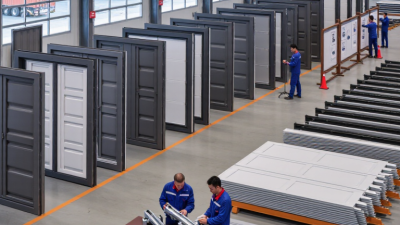
China’s leading residential overhead door manufacturers compete through practical engineering, flexible production, and export experience. Many operate integrated facilities with steel forming, panel assembly, powder coating, and hardware testing under one roof. This setup can shorten lead times and improve consistency between batches.

Their product strengths are visible in everyday details. Insulated sandwich panels help stabilize garage temperatures and reduce street noise. Galvanized hinges and reinforced brackets support repeated opening cycles in humid or coastal areas. Manufacturers also offer several surface finishes, window layouts, track systems, and lifting options for different home designs. Quiet nylon rollers and balanced spring systems can make early-morning operation less disruptive. Some factories provide custom dimensions for narrow garages or unusually high ceilings.

Reliable suppliers normally share material specifications, load ratings, installation drawings, and test records before production. Factory audits can reveal more than polished catalog photographs. Sample doors should be checked for panel alignment, seal contact, spring balance, and coating adhesion. Small gaps matter. They can become larger problems after winter exposure.

Many Chinese manufacturers are strong in customization, but quality is not automatically equal across every quotation. A lower price may reflect thinner panels, simpler hardware, or limited inspection. That weakness deserves honest attention. Buyers should confirm replacement-part availability, packaging protection, warranty terms, and technical support in writing. The best supplier is not always the largest. It is the factory that can repeatedly match the approved sample.

Export Capabilities, Customization, and After-Sales Support

China Top Residential Overhead Door Manufacturers?

Export Capabilities, Customization, and After-Sales Support

China’s leading residential overhead door manufacturers are often judged by export consistency, not catalog size. Experienced suppliers should explain container loading, moisture protection, and document control. Door panels need corner guards and separated hardware. This matters after long sea voyages. Export teams should confirm destination standards, electrical ratings, labeling, and installation rules before production. A reliable quotation states incoterms, lead time, packing method, and spare-parts policy. Vague promises create expensive surprises.

Customization goes beyond color. Manufacturers may adjust opening dimensions, panel thickness, insulation, track geometry, spring balance, windows, and control systems. A technical drawing should show tolerances and mounting clearances. I would request a sample corner detail before approving bulk production. Small errors can stop installation. Wind exposure, temperature, salt air, and garage usage should shape the specification. Not every supplier has equal engineering depth. That deserves honest checking.

After-sales support is where export capability becomes practical. Look for installation guides, exploded parts diagrams, video assistance, and trained service contacts. Replacement rollers, hinges, springs, seals, and control components should have clear identification. Remote troubleshooting can resolve sensor faults without delaying a project. Response times should be written, not assumed. Warranty terms must distinguish manufacturing defects from installation damage. Some suppliers offer impressive promises but weak follow-through. A pilot order can reveal packing quality, communication speed, and technical discipline before larger commitments.

China Residential Overhead Door Manufacturers: Key Evaluation Dimensions

This non-company-specific reference chart compares the practical factors buyers commonly use when evaluating residential overhead door manufacturers: export capability, customization, certification readiness, production capacity, and after-sales support. The percentages represent suggested evaluation weights and are intended as a structured purchasing reference rather than company performance data.